
How to Quickly Check Reading Comprehension in 2nd Grade
You just spent three days teaching main idea.
You modeled it. You practiced it together. Students worked with partners. You pulled a small group.
Everyone is nodding along.
So...did they actually get it?
That's the tricky part about teaching reading comprehension.
Sometimes students look like they understand a skill during a whole-group lesson because they're hearing other students' answers, getting prompts from you, or working through the text together.
Then you hand them a passage independently and realize:
Oh. We are not quite there yet.
But the solution isn't necessarily another giant reading assessment.
Sometimes you just need a quick way to answer one question:
Can this student independently use the reading skill I just taught?
That's where reading comprehension quick checks can be incredibly useful.
You Don't Need a Full Reading Assessment Every Time
There is absolutely a time and place for longer reading assessments.
But you don't need one every time you finish teaching a skill.
In fact, sometimes a big assessment gives you more information than you actually need.
If I've just taught students how to determine the main topic of an informational text, I don't necessarily need a multi-page assessment covering six different reading skills.
I want to know:
Can they find the main topic?
That's it.
A short passage with a few carefully focused questions can give you enough information to decide what happens next.
Do we move on?
Do we practice this skill again tomorrow?
Which students need to meet with me?
Which students are ready for independent practice?
That's useful data—and it doesn't have to eat up your entire reading block.
What Makes a Good Reading Quick Check?
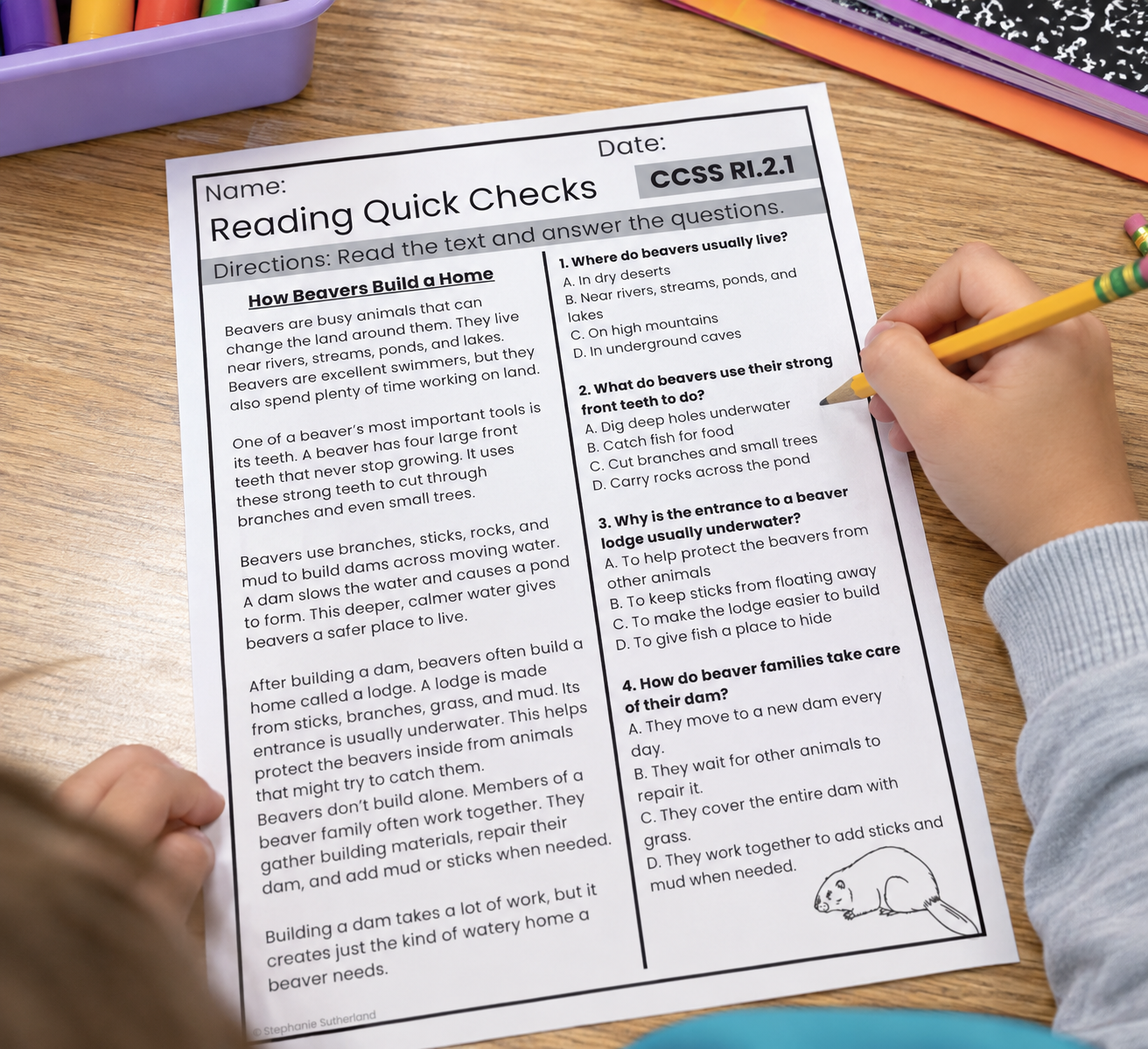
For me, a reading comprehension quick check needs to actually be quick.
Students shouldn't spend 30 minutes completing it.
I shouldn't spend my entire planning period grading it.
And it shouldn't accidentally turn into an assessment of five other skills when I'm trying to check one.
That's why I like a really simple format:
Read. Think. Answer. Done.
One short passage.
Four questions.
One reading skill.
That's enough to give me a snapshot of what a student can do independently.
Use Reading Quick Checks as Exit Tickets
One of the easiest ways to use these is at the end of a reading lesson.
Let's say you've been teaching character response.
You've read a story together, modeled how a character responds to an event, and practiced identifying those responses as a class.
At the end of the lesson, give students a short passage focused specifically on that skill.
Now you can compare what happened during instruction with what students can actually do on their own.
And because the check is short, you're not losing another day of instruction just to assess what you taught yesterday.
You can look through the responses and use them to make tomorrow's instructional decisions.
Let the Results Build Your Small Groups
This might be my favorite way to use quick checks.
Instead of guessing who needs additional support, let the student work tell you.
Imagine you give the class a quick check on point of view.
Most students demonstrate that they understand it.
Five students don't.
Great.
You don't necessarily need to reteach the entire lesson to everyone.
Those five students become tomorrow's small group.
Meanwhile, the students who demonstrated understanding can move into independent practice or begin working with the next skill.
Suddenly, that tiny reading assessment has helped you differentiate your instruction without creating an elaborate data-tracking system.
Use the Same Skill Across Fiction and Nonfiction
Here's another piece that's easy to overlook.
Students need experience thinking about comprehension across different types of text.
A student might be great at answering questions about a story but have more difficulty locating information in an informational passage.
Or they may understand vocabulary in context when reading fiction but struggle when they're encountering unfamiliar content vocabulary in nonfiction.
That's one reason I like having both fiction and nonfiction quick checks available.
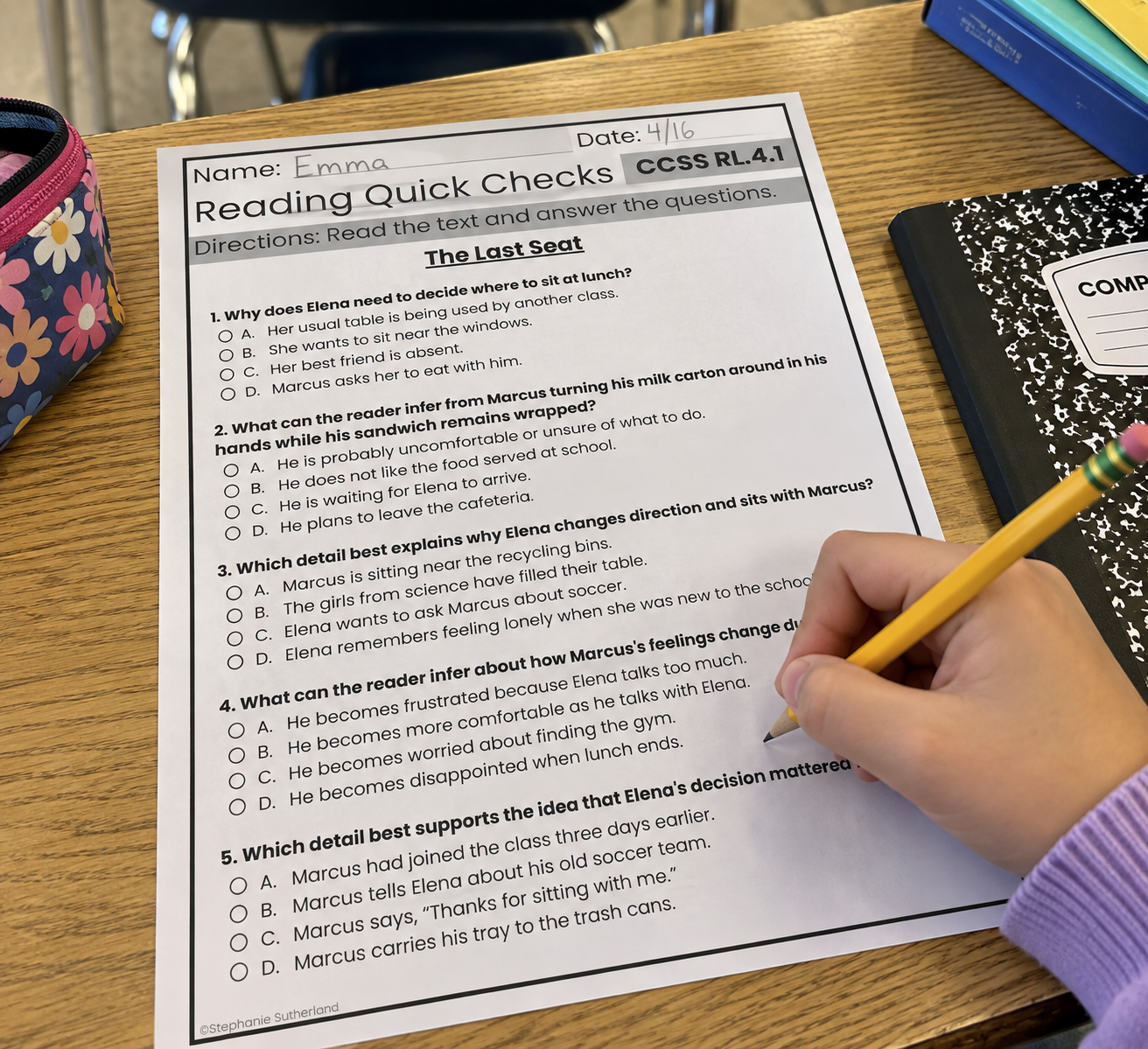
My Reading Comprehension Quick Checks Bundles include 18 fiction and 18 nonfiction quick checks, covering six literature standards and six informational reading standards. Each standard has three different passages, so you aren't limited to checking a skill once and moving on.
You can teach it.
Check it.
Reteach if necessary.
Then check it again.
That gives you a much better picture of whether students are actually beginning to own the skill.
6 Fiction Reading Skills to Check
The fiction quick checks focus on six important 2nd grade literature skills:
Asking and answering questions
Recounting stories and determining the central message
Describing characters and their responses
Determining the meaning of words and phrases
Understanding story structure
Point of view
There are three different passages for each skill.
That means you could use one after your initial instruction, save another for review, and still have a third available for intervention, reassessment, homework, or test prep.
6 Nonfiction Reading Skills to Check
The nonfiction set follows the same simple structure while focusing on informational text skills.
Students practice:
Asking and answering questions
Identifying the main topic and paragraph focus
Making connections between events, ideas, or steps
Determining the meaning of words and phrases
Using text features
Determining the author's main purpose
Again, there are three passages for each skill.
And because the format stays consistent, students aren't spending their mental energy figuring out what they're supposed to do with a brand-new worksheet every time.
They already know the routine.
Read the passage. Think about the skill. Answer four questions.
More Ways to Use Reading Comprehension Quick Checks
Once you have a stack of short reading passages available, they can do a lot more than just assess the lesson you taught that day.
I like resources that can fill several different jobs in the classroom.
These quick checks can work for:
Morning work
Reading exit tickets
Small-group instruction
Independent reading practice
Intervention
Progress monitoring
Homework
Spiral review
Test prep
Quick comprehension grades
Sub plans
You can also use them very differently depending on what your class needs.
One week, you might use them strictly as independent assessments.
Another week, you might bring one into a small group and have students talk through each question with you.
Later in the year, pull older skills back out for spiral review.
The resource stays the same. The purpose changes.
The Goal Isn't More Assessment. It's Better Information.
This is the important part.
I'm not interested in assessing kids just for the sake of collecting more grades.
Teachers already have plenty to grade.
The point of a quick check is to make your next instructional decision easier.
If almost everyone gets it, great. Keep moving.
If half the class misses it, that's useful information. You probably need another day with that skill.
If four students are struggling, you've got tomorrow's small group.
If a student struggled the first time but nails the skill after reteaching, you've got evidence that the extra instruction worked.
That's the kind of assessment data I actually want.
Simple. Specific. Useful.
36 Reading Quick Checks Ready for the Whole Year
I created the 2nd, 3rd, and 4th Grade Reading Comprehension Quick Checks Bundles to make this process as simple as possible.
The bundles include 36 reading quick checks—18 fiction and 18 nonfiction—with three passages for each of 12 different reading standards.
Every quick check includes a short, grade-appropriate passage followed by four multiple-choice questions focused on one specific comprehension skill. Answer keys are included, too, because "quick check" should also mean quick for the teacher.
No giant assessment.
No complicated new routine.
No wondering whether the student who enthusiastically nodded through your entire lesson could actually do it independently.
Just a simple way to ask:
Did they get it?
And then use the answer to decide what comes next.